Athens, Greece – October 2026
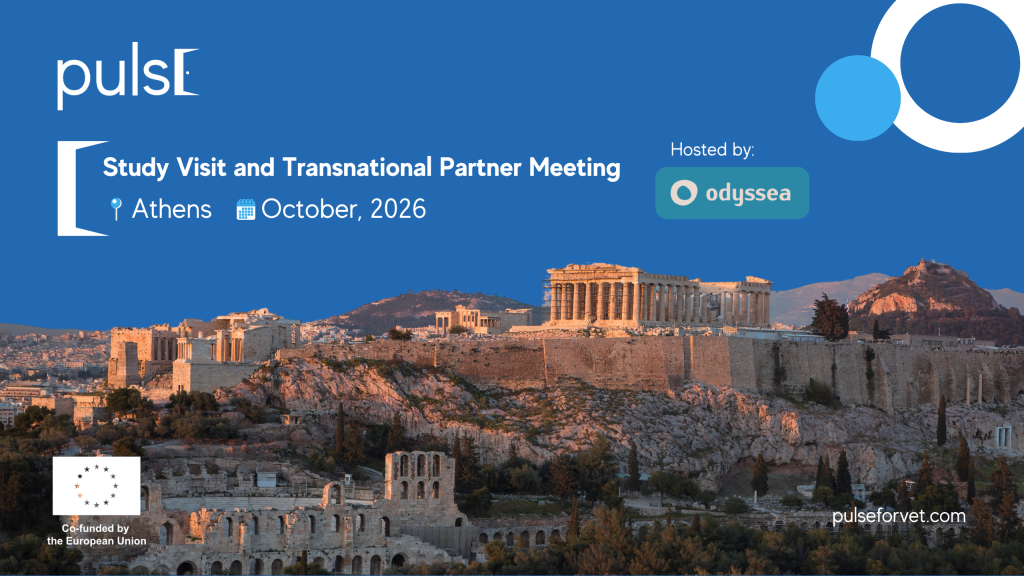
From 18 to 23 October 2026, the partnership gathers at Odyssea for a week of visits, workshops and key project decisions
By 2050, one in four people on the planet will live in Africa, and most of them will be young. That makes the continent’s youth one of the world’s greatest sources of talent, creativity and energy. PULSE (Promoting Unique Learning Strategies in Entrepreneurship) works to help young people in North Africa turn that potential into opportunities, by bringing entrepreneurial skills into vocational education and training (VET).
From 18 to 23 October 2026, the PULSE partners will meet in Athens, Greece, for their next study visit, hosted by Odyssea. The week brings together organisations from Europe and North Africa to see entrepreneurship education in action and to move the project’s concrete results forward.
Why Athens, and why Odyssea?
Odyssea is a Greek non-profit founded in 2016 that tackles social challenges through education, innovation and community engagement. Its Academy in Athens trains people in practical trades such as plumbing, woodworking and electrical work, and its FabLab supports social innovation. It is an ideal place to observe how hands-on training, makerspaces and entrepreneurship programmes reinforce one another, the very combination PULSE wants to bring to partner training centres in Tunisia, Morocco and Libya.
Learning from the local ecosystem
Partners will start with a visit to Odyssea’s Academy, including its Astro Labs and Makerspace, and an overview of its entrepreneurship programmes. They will then meet organisations from Athens’ entrepreneurial ecosystem, including Orange Grove, Female Founders Hub and New Agriculture New Generation. These visits offer concrete examples of how entrepreneurial mindsets grow outside the classroom, from supporting women founders to opening new paths in agriculture.
From inspiration to results
The visit is not only about observing good practice. It is about turning what partners see into tools that vocational schools and training centres can actually use. During working sessions, the partners will:
- Shape the training itself. Together with GIP-FIPAN (France), partners will co-design the vocational curricula that bring entrepreneurship into technical courses, as well as the tools that will assess and certify what students learn.
- Plan the Smart Lab. Calasanz (Spain) and Odyssea will work with partners on the next steps for the project’s Smart Lab, a practical space for learning by doing.
- Take stock and look ahead. Partners will reflect on the results achieved so far and those still to come, led by Calasanz and UM6P (Morocco), and will review how the project is managed, funded and quality-checked, so that it stays on track and delivers real impact.
The week closes with an evaluation of the meeting and certificates of participation. A cultural tour of Athens with Shedia will also give partners the chance to connect beyond the meeting room, which matters in a partnership of 10 organisations from 6 countries.
A project built on exchange
Inspired by the EU EntreComp framework, PULSE adapts successful teaching methods from European VET centres to strengthen vocational education in Tunisia, Morocco and Libya, so that both trainers and learners can turn ideas and opportunities into value, whether financial, cultural or social. Study visits like this one are where those methods are seen, questioned and adapted to each local context.
About PULSE:
The PULSE project is co-funded by the European Union through the Erasmus+ Programme and involves partners from Spain, France, Greece, Morocco, Tunisia, and Libya. It aims to co-create and test innovative learning strategies in entrepreneurship within VET institutions, empowering young people with the tools and mindset to succeed in today’s fast-changing labour markets.
Website: pulseforvet.com
Social Media: @pulseforvet
For media inquiries, interviews or accreditation: communication@mundusgroup.com
Funded by the European Union. Views and opinions expressed are however those of the author(s) only and do not necessarily reflect those of the European Union or the European Education and Culture Executive Agency (EACEA). Neither the European Union nor EACEA can be held responsible for them.